How to Learn Anything Faster: A Practical 7-Step Learning System
Never has it been easier to learn something new.
Want to learn photography? Thousands of tutorials are available.
Programming? Entire courses are free.
A new language? Apps, videos, podcasts, books, and AI tutors are available within seconds.
Want to understand investing, public speaking, cooking, design, mathematics, or artificial intelligence? Information is everywhere.
Yet having unlimited access to information has created an unexpected problem:
We can spend enormous amounts of time learning without becoming particularly good at anything.
We watch another video.
Save another article.
Buy another course.
Bookmark another tutorial.
And still feel like beginners.
The problem often isn’t a lack of information. It’s the absence of a good learning process.
Learning faster doesn’t mean rushing. It means spending more of your learning time doing the things that actually produce understanding and skill.
Here is a practical seven-step system you can use whenever you want to learn something new.
Table of Contents
Step 1: Define What “Learning It” Actually Means
“I’m going to learn photography.”
That’s an intention, but it isn’t yet a useful learning goal.
Photography includes composition, lighting, exposure, lenses, editing, portraiture, landscapes, wildlife photography and dozens of other skills.
A better starting point might be:
“Within one month, I want to use manual exposure and take well-exposed outdoor photographs confidently.”
Now the destination is clearer.
Similarly:
Instead of “Learn Excel,” try:
“Build a monthly business report using formulas, filters, pivot tables and charts.”
Instead of “Learn English,” try:
“Become comfortable having a five-minute conversation with a customer in English.”
Instead of “Learn programming,” try:
“Build and deploy a simple website that stores information in a database.”
Specific outcomes help you identify what you actually need to learn.
Try this
Complete this sentence:
I want to learn ______ so that I can ______.
The second blank is often more important than the first.
Step 2: Find the Essential 20%
Beginners often make the mistake of treating everything as equally important.
It rarely is.
Suppose you’re learning photography.
You could spend days researching camera sensor technology. But if your immediate goal is taking better photographs, understanding exposure, composition and light may produce much greater improvement.
The same applies to almost every subject.
When starting something new, ask:
What handful of concepts will unlock most of my early progress?
For basic personal finance, these might include:
- income versus expenses
- budgeting
- emergency savings
- debt and interest
- compound growth
- inflation
For web development:
- HTML
- CSS
- basic JavaScript
- HTTP
- databases
- deploying a website
You don’t need to understand an entire field before becoming useful within it.
Learn the foundations first.
Details become much easier to understand once you have a mental framework to attach them to.
Step 3: Learn Just Enough to Start Doing
Imagine someone wants to learn swimming.
They could spend six months studying books about swimming technique.
Would that make them a swimmer?
Obviously not.
Eventually they have to enter the water.
Yet we frequently approach intellectual and professional skills differently.
We believe:
First I will learn everything. Then I will start.
A better approach is:
Learn a little → try it → discover what you don’t know → learn that → try again.
Suppose you’re learning spreadsheets.
Watch a short introduction to formulas.
Then open a spreadsheet and create one.
You’ll probably encounter a problem.
Perhaps you don’t know how to reference another cell.
Excellent.
Now you have a specific question to learn. You can ask specific questions when you get stuck to make the next answer more useful.
Solve it and continue.
Your learning is now being guided by actual problems instead of an imaginary list of everything you might someday need.
Step 4: Turn Consumption Into Retrieval
One of the biggest traps in modern learning is confusing recognition with knowledge.
Imagine watching someone solve a mathematics problem.
Every step makes sense.
You think:
“Yes, I understand this.”
Then you close the video and try the same type of problem yourself.
Suddenly you’re stuck.
What happened?
When the solution was visible, you were recognizing the logic.
When the solution disappeared, you had to retrieve and reconstruct it yourself.
Those are different tasks.
After learning something important, close the source and ask yourself:
What did I just learn?
Then try to explain the idea clearly without looking.
You can also write down everything you remember.
This exposes gaps that passive consumption hides.
A useful rule is:
Spend less time checking whether information looks familiar and more time checking whether you can produce it yourself.
Step 5: Build Something With Your Knowledge
Projects are powerful learning tools because they combine many smaller skills around a real objective.
If you’re learning writing, publish an article.
If you’re learning programming, build an application.
If you’re learning graphic design, design a poster.
If you’re learning financial analysis, analyze a company.
If you’re learning public speaking, record a five-minute presentation.
If you’re learning cooking, cook the dish.
Projects reveal something tutorials cannot:
the difference between knowing about something and being able to do it.
Suppose you’ve watched ten tutorials explaining how websites work.
You may feel knowledgeable.
Now try building one from an empty folder.
Questions immediately appear:
How should the pages be organized?
How do I make the navigation responsive?
Where should images go?
How do I deploy it?
Each problem gives your learning direction.
This is why practical projects often accelerate learning dramatically.
Step 6: Create Fast Feedback Loops
Practice alone isn’t enough.
You can practice something incorrectly for years.
Effective learning requires feedback.
Imagine practicing pronunciation in a new language while consistently saying a word incorrectly.
Without feedback, repetition simply reinforces the mistake.
Feedback can come from many places:
A teacher can identify misunderstandings.
A colleague can review your work.
Software can tell you whether your answer is correct.
Customers can show whether your solution works.
Tests can reveal gaps in your knowledge.
Your own results can provide feedback too.
The shorter the distance between action and useful feedback, the faster you can adjust.
Try thinking of learning as a loop:
Attempt → Feedback → Correction → Attempt again
Rather than:
Study → Study → Study → Someday attempt
Step 7: Revisit What Matters
Learning something once doesn’t guarantee you’ll remember it.
Fortunately, you don’t need to continually relearn everything.
Instead, periodically retrieve the most important concepts.
Suppose you’ve learned five essential ideas today.
Tomorrow, before looking at your notes, try writing them down.
A few days later, explain them again.
A week later, use them in a project.
This creates repeated opportunities for your brain to retrieve the information.
The important distinction is:
Don’t simply reread your notes.
Try remembering first.
Then check.
The difficulty you experience while recalling something can actually make the review more valuable.
The Complete Learning Loop
Put the seven steps together and you have a reusable system:
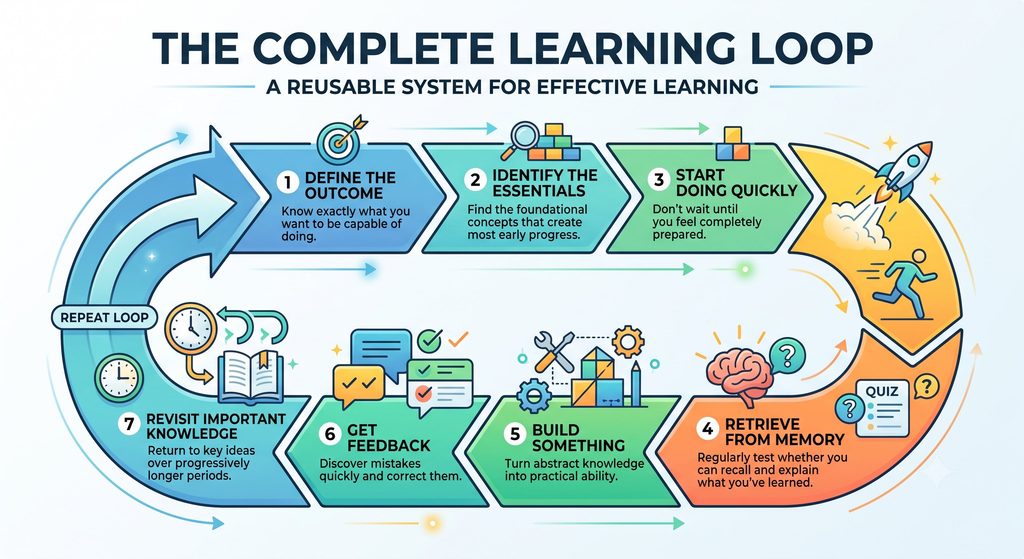
1. Define the outcome
Know exactly what you want to be capable of doing.
2. Identify the essentials
Find the foundational concepts that create most early progress.
3. Start doing quickly
Don’t wait until you feel completely prepared.
4. Retrieve from memory
Regularly test whether you can recall and explain what you’ve learned.
5. Build something
Turn abstract knowledge into practical ability.
6. Get feedback
Discover mistakes quickly and correct them.
7. Revisit important knowledge
Return to key ideas over progressively longer periods.
The process isn’t strictly linear.
It looks more like:
Learn → Try → Fail → Investigate → Understand → Try Again → Improve
That’s what real learning often looks like.
An Example: Learning AI in 30 Days
Suppose you decide:
“I want to learn artificial intelligence.”
That’s enormous.
Instead, define the outcome:
“In 30 days, I want to understand how modern AI language models work well enough to explain them and build a simple application using one.”
Now identify the foundations:
- machine learning
- training data
- neural networks
- tokens
- language models
- prompts
- inference
- APIs
Learn enough about each to understand the overall picture.
Then build something small.
Perhaps:
A question-answering assistant for your own notes.
While building it, you’ll discover gaps.
What is a context window?
Why does the model sometimes invent information?
How should prompts be structured?
How much does an API request cost?
Now these concepts aren’t abstract vocabulary.
They solve problems you actually have.
That’s much more memorable.
Beware of the Tutorial Trap
Modern learning platforms make it extremely easy to feel productive.
You can spend three hours watching educational videos and finish the evening feeling accomplished.
Sometimes you genuinely learned a great deal.
But ask yourself:
What can I do now that I couldn’t do three hours ago?
If the answer is unclear, you may have consumed more than you learned.
This doesn’t mean tutorials are bad.
They’re enormously useful.
But tutorials should support practice rather than replace it.
A useful pattern is:
20 minutes learning → 40 minutes doing
The exact ratio doesn’t matter.
The principle does.
Don’t Optimize for Speed Too Early
There’s an irony in trying to learn faster.
You can become so obsessed with optimization that you spend more time researching learning techniques than learning the thing itself.
Which note-taking application is best?
Which course is perfect?
Which productivity system should you use?
Should you study for 25 minutes or 50?
Eventually, optimizing the process becomes procrastination.
You don’t need the perfect system.
You need a reasonable system that you actually use.
A notebook and consistent practice can outperform an elaborate productivity setup that you abandon after two weeks.
Measure Ability, Not Hours
Imagine two people learning programming.
Person A says:
“I’ve studied programming for 300 hours.”
Person B says:
“I’ve built five working applications.”
Which statement tells you more about ability?
Time matters, but outcomes matter more.
Instead of tracking only:
Hours studied
consider tracking:
Problems solved
Projects completed
Concepts explained without notes
Skills demonstrated
Mistakes corrected
Those are stronger signals of actual learning.
A Simple Weekly Learning Routine
You can apply the system without restructuring your entire life.
Suppose you have just 30 minutes a day.
Monday
Learn one important concept.
Tuesday
Recall Monday’s concept and learn the next one.
Wednesday
Practice both.
Thursday
Learn something needed to solve problems encountered during practice.
Friday
Build something small.
Saturday
Review your mistakes and get feedback.
Sunday
Without notes, explain what you learned during the week.
Thirty minutes per day equals only three and a half hours per week. To make those minutes count, build a focused learning session with fewer interruptions.
But focused learning accumulated over months can become substantial expertise. Use a weekly learning review to check what you can do independently and choose your next practice task.
The Skill That Makes Every Other Skill Easier
We usually think about learning as something we do at school.
But learning is itself a lifelong skill.
Technology changes.
Industries change.
Jobs change.
Tools change.
Our responsibilities change.
The specific knowledge you have today will not always be enough.
But the ability to enter an unfamiliar subject, identify what’s important, practice intelligently, correct mistakes, and gradually become competent remains valuable throughout life.
So the next time you decide to learn something new, don’t begin by collecting twenty courses.
Choose one outcome.
Learn the essentials.
Start doing.
Test yourself.
Make mistakes.
Get feedback.
Return tomorrow.
You don’t need to learn everything.
You need to keep getting better at learning what matters.
A practice plan you can complete before choosing another course
Use this worksheet for one skill you need in a real task. The example below concerns an office assistant learning spreadsheet formulas. It is a worked example, not a record of measured results.
| Planning question | Worked example | Your entry |
|---|---|---|
| What must I do independently? | Calculate order totals from quantity and unit price, then apply a discount before adding tax. | Name a task someone could observe. |
| What will I use? | A blank spreadsheet with fictional orders; the software’s official formula documentation. | Choose one reference and one practice file. |
| What will my first attempt test? | Create formulas for five orders without replaying a tutorial. | Choose a small task you can finish in one sitting. |
| How will I check it? | Calculate one order manually and compare it with the formula result. Change an input and check that the total updates. | Write a check that could expose a wrong answer. |
| What will count as progress? | Complete a fresh order sheet without copying the earlier formulas, and explain the calculation order. | Describe what you can do with less help. |
| When will I practise again? | Choose a realistic time in the coming week; repeat the task with different figures. | Write a time and a fresh test. |
For the first order, use quantity 4 and unit price ₹250. The subtotal is ₹1,000. With a 10% discount, the discounted amount is ₹900. Adding a fictional 18% tax to that amount gives ₹1,062. The tax rate is only an arithmetic input for this exercise; it is not advice about the tax applicable to any product.
Now change the quantity to 6. Before checking the spreadsheet, calculate the expected total yourself. Check that the discount and tax are being applied to the intended amounts. A formula that works only for the original figures has not passed the test.
Keep the first attempt, record where you needed help and use the weekly learning review to choose the next exercise. If the calculation is wrong, correct the specific step rather than restarting an entire course.
Start with the worksheet and keep one completed attempt. It will give your next learning session a specific problem to solve.
FAQ
What is the fastest way to learn something new?
Start by defining a specific outcome, learn the foundational concepts, and begin practicing as soon as possible. Combine practice with active recall, feedback and periodic review rather than relying entirely on passive reading or watching.
How many hours a day should I spend learning?
There is no universal requirement. Even 20–30 minutes of focused daily learning can accumulate significantly over time. Consistency and the quality of practice are often more useful measures than simply counting hours.
Why do I understand tutorials but struggle by myself?
Tutorials provide the information and often the solution at the same time. Working independently requires you to retrieve knowledge, decide what to do next and solve unexpected problems. Practicing without the tutorial is therefore an important part of developing independent ability.
Should I learn one thing at a time?
For a specific skill, having one primary learning goal can reduce distraction. You don’t necessarily need to abandon every other interest, but concentrating your deliberate learning effort makes it easier to accumulate meaningful progress.
Can you really learn a skill in 30 days?
Thirty days can be enough to build useful beginner-level competence in many subjects, but mastery usually requires considerably longer. A better goal is measurable improvement rather than an arbitrary promise of mastery.
Also read : Why We Forget What We Learn — and How to Remember More